


Global entertainment, science, and educational YouTube channels are sharply divided along genre and economic lines when localizing for Vietnam. Flagship entertainment powerhouses—including MrBeast, gaming creator Preston, and major children’s franchises—rely heavily on human Vietnamese voice actors to preserve comedic timing, vocal intensity, and watch-time retention. By contrast, science, engineering, and institutional education channels are selectively adopting AI-generated or hybrid human-in-the-loop (HITL) dubbing—or bypassing Vietnamese audio altogether in favor of subtitles. Crucially, as of late 2026, YouTube’s free native Auto-Dubbing feature does not support English-to-Vietnamese translation (it only auto-dubs from Vietnamese into English). Every international channel offering a Vietnamese audio track today is therefore making a deliberate investment through custom Multi-Language Audio (MLA) uploads or dedicated Vietnamese sub-channels, forcing producers to navigate a stark commercial paradox: Vietnam boasts nearly 64 million ad-reachable YouTube users, yet sits in YouTube’s lowest advertising revenue tier.
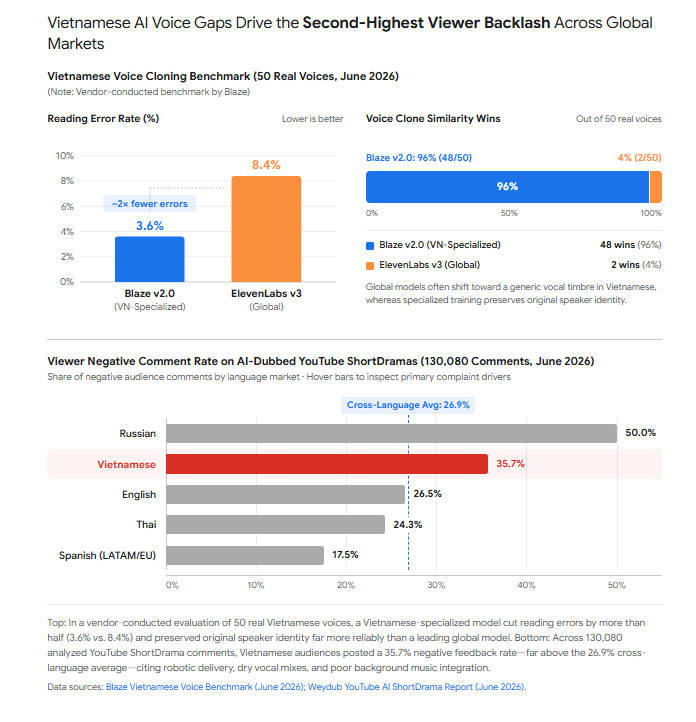
In terms of quality, Vietnamese AI voice synthesis has advanced rapidly since 2024 and now produces clean, intelligible audio suitable for scripted, single-narrator science explainers and tutorials when paired with native human script adaptation. However, for high-energy entertainment, multi-speaker challenges, and comedy, AI still falls well short of professional human voice acting. Vietnamese presents formidable acoustic and linguistic hurdles—including six lexical tones, a dynamic kinship pronoun system (xưng hô), substantial syllable expansion during translation, regional Northern-versus-Southern dialect expectations, and frequent English code-switching—that still trip up international models. Vietnamese viewers are correspondingly strict: a June 2026 analysis of more than 130,000 YouTube comments published by localization platform Weydub recorded a 35.7% negative sentiment rate among Vietnamese viewers—the second highest among tracked markets behind only Russia—driven largely by flat robotic delivery, awkward literal phrasing, and poorly mixed background audio.
Between 2026 and 2030, the market is converging neither on raw self-serve AI nor on expensive Western broadcast dubbing houses, but on Hybrid Human-in-the-Loop workflows and licensed regional voice cloning. Producers aiming to localize into Vietnamese should not wait passively for YouTube’s native auto-dubbing. Instead, they should validate organic Vietnamese demand via translated metadata first, deploy human-transcreated hybrid AI for informational and STEM formats where view volumes cannot support full human casts, and contract directly with local Hanoi or Ho Chi Minh City dubbing studios for high-energy entertainment formats where superior viewer retention unlocks algorithmic distribution.
The Structural Context: Vietnam’s Audience Scale vs. The Platform and Revenue Bottleneck
Understanding why global creators choose human talent, AI voices, or subtitles when approaching Vietnam requires examining three structural realities shaping the Vietnamese YouTube ecosystem in late 2026: massive mobile-first consumption, a conspicuous directional gap in YouTube’s native AI tooling, and deeply compressed domestic AdSense rates.
Vietnam ranks among YouTube’s most penetrated digital markets in Asia-Pacific. Based on Google’s advertising planning tools tracked by DataReportal in October 2026, YouTube reached 63.9 million ad-reachable users in Vietnam (up from 62.1 million in late 2025), placing the country just behind Germany (68.8 million) and ahead of the Philippines (62.0 million) and Turkey (61.0 million). At YouTube Festival Vietnam in September 2026, Google further reported that YouTube reaches 93% of Vietnam’s internet users daily, supported by an 84.4% smartphone penetration rate and rapid mobile broadband growth. In such a mobile-first viewing environment, dubbed audio holds a clear consumption advantage over subtitles because viewers can listen hands-free rather than reading small text on phone screens.
Despite this audience density, global English-language creators face an immediate platform bottleneck. After a two-year pilot with top creators, YouTube opened custom Multi-Language Audio (MLA) track uploads to millions of channels in September 2025—reporting that participating channels generated over 25% of their total watch time from non-primary languages as of July 2025—and expanded its free, Gemini-powered Automatic Dubbing globally to all eligible channels in February 2026, after logging roughly six million daily viewers watching at least ten minutes of auto-dubbed content in December 2025. Yet YouTube’s official Help Center documentation as of October 2026 reflects a pronounced directional asymmetry: while YouTube automatically dubs videos from 29 non-English languages (including Vietnamese) into English, it only auto-dubs from English into 20 target languages. English-to-Vietnamese is omitted from native auto-dubbing, alongside Thai, Turkish, and Chinese. Likewise, YouTube’s “Expressive Speech” tier—designed to replicate a speaker’s original pitch and emotional energy—covers only eight major languages and excludes Vietnamese.
Simultaneously, domestic advertising economics impose tight constraints on localization spend. Across channels connected to analytics platform Dynamoi between November 17, 2025 and November 15, 2026 (a connected-channel benchmark rather than an official countrywide rate), Vietnam averaged a Creator RPM of just $0.162 per 1,000 views ($162 per million views)—ranking 70th out of 86 published markets and sitting 85% below the $1.09 all-market weighted average. Industry estimates from CreatiCalc (updated September 2026) similarly place Vietnam in Tier 4 (Low-CPM Markets) with estimated cross-niche CPMs of $0.50–$2.00 and blended RPMs of $0.20–$0.80, compared with $6.00–$20.00 CPM and $3.00–$9.00 RPM in the United States—a twelvefold gap at the range midpoints ($0.50 vs. $6.00) on identical view counts. Creator network MediaCube (2026) estimates slightly higher Vietnam/Thailand CPMs of $1.00–$3.50, still far below Tier-1 Western markets.
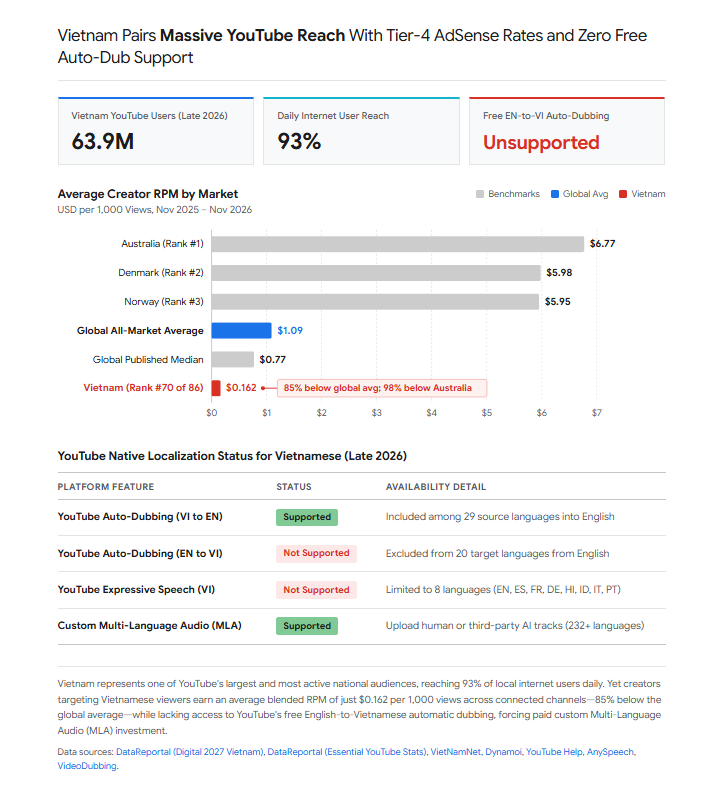
Two structural caveats soften Vietnam’s headline RPM figure. First, Dynamoi’s $0.162 average reflects brief session lengths (1.6 minutes per view versus 10.8 minutes globally) and low monetized playback density (25 ad playbacks per 100 views versus 72 globally). Longer, high-intent videos running 8 to 15 minutes with multiple mid-roll ad slots perform noticeably better: an informal March 2026 survey of 150 Vietnamese creators published by AI content platform CoolMe (self-reported vendor blog data rather than audited YouTube telemetry) placed Vietnamese gaming channels at $0.80–$2.00 RPM, entertainment at $1.00–$3.00, lifestyle at $2.00–$5.00, and Vietnamese-language business, e-commerce, and AI/technology channels at $3.00–$7.00. Second, Google disclosed at YouTube Festival Vietnam 2026 that more than half of watch time on content produced by Vietnamese channels comes from overseas audiences, signaling that well-executed Vietnamese audio tracks also reach affluent Vietnamese diaspora communities in the United States, Australia, Canada, and Europe, lifting blended channel RPM well above purely domestic averages.
How Global YouTube Channels Actually Dub for Vietnam Today
Because YouTube does not automatically generate Vietnamese dubs for English uploads, international channels fall into distinct operational models governed by genre, audience ceiling, and budget. Importantly, YouTube does not label whether a creator’s custom MLA track was recorded by human voice actors or produced via a third-party AI tool (only YouTube’s own automated tracks carry an “auto-dubbed” tag). Even so, public dubbing cast registries, localization agency portfolios, official corporate release logs, and community documentation reveal clear industry patterns.
| Global Channel / Franchise | Genre & Scale | Official Vietnamese Audio Status | Primary Dubbing Method (Verified / Documented) | Distribution Architecture |
| MrBeast | Mega-Entertainment & Challenges (471M main subs; 800M+ across 16 localized channels) | Active official Vietnamese MLA track (30+ languages total) | Human Voice Actors (Jimmy Donaldson voiced by veteran Vietnamese actor Huỳnh Phương Hoàng Trí via in-house unit Creator Global) | Consolidated MLA on main channel (alongside legacy localized channels in top markets) |
| Preston | Gaming & Youth Entertainment | Active official Vietnamese MLA track (among 7 dubbed languages) | Human Voice Actors (produced by New York agency Human Voice Over since mid-2025) | Custom MLA tracks on main channel |
| Like Nastya / Vlad and Niki | Kids’ Entertainment (Like Nastya: 239M+ combined subs) | Massive dedicated Vietnamese channels (Like Nastya VNM, Vlad và Niki) plus MLA | Historically Human / Agency Localized (multi-year dedicated kids’ dubbing operations; current per-video AI usage undisclosed) | Dedicated Vietnamese channels + MLA (“Dubbed” tracks) |
| Mark Rober | Science & Engineering (65.9M to 79M+ subs across 2025–2026 reports) | Active official Vietnamese MLA track (30+ languages released day one) | Hybrid Mix — YouTube does not disclose the split; dubbing records confirm human casts via Creator Global in flagship markets (e.g., Latin American Spanish) while noting AI voice replication on a majority of secondary dubs | Consolidated MLA on main channel, simultaneous global release |
| Veritasium | Deep-Dive Science (20M+ subs) | No verified official Vietnamese dub found; Vietnamese viewers rely on subtitles or browser AI extensions | Mixed Human & AI Pilots across global languages — human agencies (Unilingo, BeMultilingual) alongside Electrify Video Partners’ AI pilots (Papercup/RWS) and CineLingo/Familiar Labs | Consolidated MLA + legacy localized channels in major markets |
| Kurzgesagt – In a Nutshell | Science Animation (~25M main subs) | No official Vietnamese dub (Vietnamese subtitles available; fans use browser AI extensions) | Strictly Human across 8 official localized channels (DE, ES, PT, KO, FR, JA, AR, HI); strong community opposition to AI voices | Separate localized channels for top 8 markets + 35+ subtitle languages on main |
| TED / TED-Ed | Education & Lectures (19M+ TED-Ed subs) | Official AI dubbing expanding via TED app; only tiny unofficial Vietnamese YouTube channels (~2K subs) | AI Dubbing Adopted Officially — TED launched TED Fluent (powered by Panjaya AI) in November 2026 across its mobile app | App-based AI dubbing (TED Fluent) + community subtitles on YouTube |
| Mid-Tier & Long-Tail Global Creators | Tech, Tutorials, Finance, Explainers | Sporadic custom MLA or none | Self-Serve AI or Hybrid HITL (ElevenLabs, HeyGen, Rask AI, CAMB.AI, Dubformer) where ROI permits | Custom MLA on main channel |
High-Energy Entertainment and Kids’ Franchises: The Human Stronghold
At the top of global entertainment, human Vietnamese voice acting remains the dominant choice. Casting records on The Dubbing Database confirm that Jimmy Donaldson’s Vietnamese track on MrBeast is voiced by Huỳnh Phương Hoàng Trí, a professional Vietnamese voice actor active since 2014 whose theatrical credits include Disney’s 2019 Aladdin, Spider-Man: Across the Spider-Verse, Inside Out 2, and major anime dubs. MrBeast’s internal localization division, Creator Global, applies a full human-casting approach across its core markets—documenting large multi-actor casts in languages such as Thai and Spanish—so that rapid-fire banter, breathless countdowns, and exaggerated reactions maintain the high-retention pacing that defines the brand.
Similarly, gaming and challenge creator Preston partnered with New York human-dubbing studio Human Voice Over starting in mid-2025 to upload human-voiced MLA tracks in seven languages, explicitly including Vietnamese alongside Spanish, Brazilian Portuguese, Arabic, French, Indonesian, and German. In children’s media, global juggernauts Like Nastya and Vlad and Niki illustrate how early localization established massive Vietnamese audiences: Like Nastya VNM routinely accumulates tens of millions of views per video (including individual hits exceeding 269 million views), while Vlad và Niki compilations have crossed 200 million to 645 million views. Because young children cannot read subtitles and respond immediately to expressive vocal acting, multi-language dubbing propelled Like Nastya from roughly 112 million to 239.2 million subscribers (+113%). Even at low Vietnamese CPMs, massive view volume makes full localization commercially viable.
Science, Engineering, and Educational Channels: Pragmatic Hybridization and Unserved Demand
Science and educational channels follow a far more selective path, balancing factual credibility and narrower genre ceilings against localization costs.
Mark Rober represents YouTube’s most visible benchmark for simultaneous global MLA scaling, averaging more than 30 audio languages per video—including Vietnamese—available on release day. While YouTube does not publicly specify how Rober’s team produces each language track, secondary production records point toward a tiered hybrid strategy: The Dubbing Database documents human voice casts recorded via Creator Global for flagship markets like Latin American Spanish (even casting the official regional voice actor for Phineas in a Phineas and Ferb crossover build), while noting that “a majority of the other dubs of the video… use AI to replicate Phineas’ original English voice actor in other languages.” Meanwhile, AI lip-sync and dubbing vendor blogs (such as Sync.so) cite Rober as an early adopter of AI-assisted dubbing workflows to sustain day-one global releases across 30+ tongues.
Veritasium, co-owned by creator-investment firm Electrify Video Partners, reflects a comparable blend of human craft and AI experimentation across its global footprint. Historically, Veritasium built international reach through human partners—including Unilingo (which grew a human-dubbed Veritasium channel to 2 million subscribers), volunteer Russian studio Vert Dider (since 2015), and full-service human agency BeMultilingual (which lists Veritasium among its flagship clients and offers human dubbing in 40+ languages). At the same time, Electrify Video Partners partnered with AI dubbing pioneer Papercup (whose technology was later acquired by enterprise vendor RWS) to dub Veritasium into Portuguese, and worked with visual-translation specialists at CineLingo/Familiar Labs. Notably, no verified official Vietnamese audio track for Veritasium was confirmed in public listings; third-party browser extension providers like AutoDub specifically market their real-time Vietnamese AI dubbing by citing Veritasium and Kurzgesagt as channels Vietnamese viewers still cannot watch officially in Vietnamese.
Munich-based science animation studio Kurzgesagt – In a Nutshell illustrates the deliberate human-only ceiling. While its main English channel (~25 million subscribers) carries subtitles in 35+ languages, Kurzgesagt operates eight separately managed, human-narrated channels—German (~2.5 million subscribers), Spanish (~2.2 million), Portuguese (800,000+), Korean (737,000+), French (300,000+), Japanese (130,000+), Arabic (75,000+), and Hindi (50,000+)—delivering roughly 22% overall subscriber expansion. Kurzgesagt has not launched an official Vietnamese dub, reflecting both the tighter audience ceiling of hard science in developing markets (evidenced by Hindi sitting at 50,000 subscribers despite India’s vast population) and its loyal audience’s fierce resistance to AI voices, seen when Reddit fans protested even unverified speculation that narrator Steve Taylor’s voice had been synthetically altered in a deleted Short.
Institutional education, by contrast, is now adopting AI dubbing overtly. In November 2026, TED introduced “TED Fluent,” rolling out AI-dubbed TED Talks powered by Panjaya AI directly inside its mobile app (featured across global App Store release logs including Vietnam, though the exact per-language rollout list is not specified in the changelog). On YouTube itself, official Vietnamese TED-Ed audio remains absent, leaving demand fragmented across tiny unofficial repost channels like @TededtiengViet (~2,040 subscribers).
Quality Assessment: Vietnamese AI Voices vs. Human Voice Actors in Late 2026
Judging where Vietnamese AI dubbing stands relative to human voice talent requires separating surface acoustic smoothness—where modern neural speech models sound impressively clean—from tonal accuracy, vocal identity, and cultural delivery, where Vietnamese remains one of the most challenging languages in speech AI.
State of the Technology: Global Platforms vs. Vietnamese-Specialized Models
No independent, peer-reviewed academic benchmark evaluating commercial AI dubbing platforms specifically on Vietnamese YouTube audio was found in public sources; the clearest quantitative evaluation available is a June 2026 benchmark published by Vietnamese voice-AI vendor Blaze, testing Blaze v2.0 against ElevenLabs v3 and Flash models across 50 real Vietnamese voice recordings. Because this is a vendor-conducted study, its margins should be treated with appropriate caution, yet the underlying technical failure modes closely mirror independent reviews and Vietnamese studio feedback.
First, even on ElevenLabs—widely viewed as the global standard for expressive AI speech—Vietnamese support comes with notable architectural caveats. As of late 2026, ElevenLabs’ consistent long-form model, Multilingual v2, does not support Vietnamese. Creators generating Vietnamese on ElevenLabs must rely on Eleven v3 (70–74 languages, responsive to bracketed directorial cues such as [whispers], [laughs], [excited], and [sarcastically]) or low-latency Flash v2.5 / Turbo v2.5 models. While Eleven v3 delivers remarkable emotional range, technical documentation from Artlist and independent product reviews caution that v3 exhibits generation-to-generation inconsistency and stability issues, frequently shifting pacing or vocal profile across long scripts and forcing repeated, costly regenerations.
Second, general international models still show elevated error rates on Vietnamese phonetics, code-switching, and speaker cloning. In Blaze’s 50-voice Vietnamese cloning test, ElevenLabs registered an ~8.4% reading error rate—more than double Blaze’s ~3.6% error rate—and lost the original speaker’s timbre on 48 out of 50 voices, returning a polished yet generic Vietnamese voice that sounded like a different person. Tellingly, ElevenLabs’ Flash model scored highest among all tested models on raw audio smoothness (“naturalness”) while scoring lowest on voice-cloning similarity. English-Vietnamese code-switching—routine on tech, business, and pop-culture YouTube channels—triggered telling errors: when prompted with the line “Nếu mà chị banking thì chị banking được bao nhiêu tiền trước?”, ElevenLabs misread “banking” as “bán kinh”, whereas the Vietnamese-trained model pronounced the loanword accurately.
Third, domestic Vietnamese TTS ecosystems—led by Vbee AIVoice (reporting over 3 million individual users and 500 enterprises, 20 Vietnamese voices across regions, and SRT-synced dubbing), Viettel AI (16 voices spanning Northern, Central, and Southern accents), FPT.AI (10 regional voices, shifting away from individual Console plans in August 2026 toward enterprise API Marketplace offerings), Zalo AI, and newer tools like SaydiVoice and AnySpeech—consistently outperform generic global engines on lexical tones, Sino-Vietnamese (Hán-Việt) vocabulary, and authentic regional dialects. Yet most domestic platforms remain tailored toward news narration, e-learning, IVR, and short-form social clips rather than cross-lingual, multi-speaker video dubbing with emotion transfer. Bridging that gap is the focus of specialized enterprise localization platforms—including CAMB.AI (agentic dubbing explicitly supporting Vietnamese with speaker preservation), Dubformer (supporting vi-VN with emotion transfer and pronunciation glossaries), HeyGen (175+ languages with lip-sync), Rask AI (130–135+ languages, though reviewers note occasional monotonic cloning), and enterprise engines like Deepdub (130+ languages).
Five Structural Barriers Where Human Voice Actors Still Outperform AI in Vietnamese
Even as neural voice quality improves rapidly, five linguistic and acoustic properties of Vietnamese preserve a decisive performance edge for skilled human actors.
The acoustic conflict between six tones and emotional expression sits at the heart of the gap. Whereas English expresses excitement, sarcasm, or urgency primarily through pitch inflection, stress, and volume, standard Northern Vietnamese encodes lexical meaning directly into six distinct fundamental frequency (F0) contours (ngang, huyền, sắc, hỏi, ngã, nặng), while Southern dialects operate on five (merging hỏi and ngã), distributed across more than 7,000 syllables with stacked vowel-and-tone diacritics (such as ố, ồ, ổ, ỗ, ộ). Shifting pitch casually on the syllable ma transforms the meaning across six unrelated words (ma ghost, má mother, mà but, mả tomb, mã horse, mạ rice seedling). As Vietnamese audio engineers at VNVO Studio observe, veteran Vietnamese voice actors function almost like vocalists—conveying urgency, humor, or grief through breath control, glottal tension, and micro-pauses without violating tonal boundaries. Generative AI models frequently fall into a dilemma: either keeping delivery flat to preserve tonal accuracy, or bending pitch contours awkwardly when directed toward high excitement.
The kinship pronoun system (xưng hô) magnifies translation errors that do not exist in English. Where English uses an invariant “I / you” pair, Vietnamese requires dynamic selection from an intricate social hierarchy of age-, gender-, and status-dependent terms (anh, chị, em, tôi, mình, bạn, tao, mày, ông, bà). Fully automated dubbing pipelines lack visual and social context regarding who is speaking to whom, frequently defaulting to stiff textbook “tôi – bạn” exchanges or switching pronouns mid-scene—an immediate immersion breaker that open-source Vietnamese dubbing tools now attempt to patch with manual xưng hô character tables.
Syllable expansion and pacing compression routinely ruin literal AI translations. According to Vietnamese dubbing pacing analyses published by VNVO Studio, an English video narrated at a brisk 160 words per minute (WPM) forces a literal Vietnamese translation past 200 WPM to stay synchronized inside the original timecodes—far exceeding the natural Vietnamese listening benchmark of 130–150 WPM. Without human transcreation to condense phrasing and preserve breathing room, AI dubbing sounds frantic and exhausting.
Regional dialect alignment further separates local craft from generic automation. Northern (Hanoi) Vietnamese preserves all six tones crisply with sharper high-frequency sibilants (around 6–8 kHz) and serves as the authoritative standard for VTV national broadcasts, documentaries, and formal education. Southern (Ho Chi Minh City/Saigon) Vietnamese softens hard fricatives (v toward y, r toward soft g), yielding a warmer, more melodic cadence preferred for entertainment, comedy, consumer advertising, and most of the global Vietnamese diaspora. Because global AI dubbing models typically offer a single standardized voice profile rather than true dialect casting, entertainment channels risk sounding overly stiff or culturally mismatched.
Acoustic “proof of life” and stem mixing round out the human advantage. In 2026, listeners increasingly recognize hyper-clean, breath-free audio—with unnatural silence between words—as algorithmic. During intense moments such as a challenge contestant panicking, a gamer reacting to a jump scare, or an actor delivering sarcastic timing, genuine throat tension, irregular breathing, and clean vocal mixing against preserved background music and sound effects remain difficult for automated pipelines to replicate consistently.
Current Readiness Assessment by Content Genre
Because no standardized independent percentage score exists for Vietnamese AI-versus-human dubbing parity, the most rigorous way to evaluate readiness in late 2026 is by qualitative production tier grounded in documented vendor accuracy benchmarks, industry MOS quality thresholds (Dataintelo cites MOS 4.0+ for e-learning versus 4.3+ for media/entertainment), and real-world creator deployments:
| Content Category | Vietnamese AI Readiness Tier (Late 2026) | Where AI Performs Reliably | Where Human Intervention Remains Essential |
| Science Explainers, Tech Reviews & Tutorials (Single Narrator, Scripted) | High Readiness (Hybrid Viable) | Clean, steady articulation on structured informational scripts; scalable backlist localization at low cost. | Native script transcreation (130–150 WPM), fixing code-switched English STEM terms, and auditing tonal accuracy. |
| Documentaries & Long-Form Podcasts | Moderate-to-High Readiness (Hybrid Viable) | Eliminates subtitle fatigue across 1–3 hour episodes; maintains consistent voice identity across long runtimes. | Handling overlapping interviews, dry humor, authoritative pacing, and ensuring voice-clone consistency across segments. |
| Kids’ Content & Animation | Low-to-Moderate Readiness (Human Preferred) | Basic multi-speaker separation and rapid prototyping for simple educational clips. | Playful character voices, energetic exclamations/singing, and warm, child-friendly dialect casting. |
| High-Energy Entertainment, Comedy, Gaming & Short Dramas | Low Readiness (Human Stronghold) | Fast market-validation pilots on Shorts or trailers before committing studio budgets. | Dynamic xưng hô banter, localized Vietnamese slang/humor, shouting/crying/laughing realism, and tight punchline timing. |
Audience Reactions: Why Vietnamese Viewers Push Back—and When They Engage
Evidence from 2025–2026 points to a consistent behavioral rule: viewers do not reject AI dubbing in the abstract—they reject cheap execution, emotional flatness, and forced playback.
In June 2026, AI dubbing vendor Weydub released a large-scale sentiment audit covering 130,080 viewer comments on AI-dubbed YouTube ShortDramas across five language groups. Overall, 26.9% of comments were negative, with robotic dubbing standing out as the single biggest cross-language complaint. Crucially, Vietnamese audiences recorded a 35.7% negative comment rate—more than double Spanish (17.5%) and substantially above Thai (24.3%) and English (26.5%), trailing only Russia (50.0%). Comment breakdowns highlighted three specific Vietnamese pain points: voices that sounded like mechanical reading rather than acting, degraded or missing background music (BGM), and a “dry vocal mix” detached from the scene. Yet the same report underscored enormous Vietnamese appetite for localized foreign entertainment when executed cleanly: two Vietnamese ShortDrama channels, OneTV (4.42 million subscribers, 602 million total views) and Yêu Phim (3.32 million subscribers, 438 million views), ranked #6 and #10 globally in their category.
Viewer irritation carries a steep algorithmic penalty through watch-time collapse. In controlled dubbing tests conducted by AIR Media-Tech on a wildlife YouTube channel (reported via MilX in October 2026), an AI-only English audio track held viewers for an average of 1 minute 22 seconds, whereas professionally human-dubbed tracks on the exact same videos retained viewers for 3 minutes 40 seconds to 5 minutes 19 seconds—a 2.7x to 3.9x watch-time advantage. Although that test measured English tracks rather than Vietnamese specifically, the underlying platform mechanism is universal: lower retention shrinks mid-roll ad inventory and signals weak satisfaction to YouTube’s recommendation engine, reducing total impressions and revenue long before comment criticism mounts. Similarly, an internal commercial test in Ho Chi Minh City reported by human-dubbing provider VNVO Studio (which warrants caution given vendor incentives) found viewers abandoning a synthetically voiced Vietnamese fintech launch video at 4.2 seconds versus 18.7 seconds for a human actor.
Audience tolerance, however, shifts markedly by genre. A University of Jyväskylä study cited in Kapwing’s 2026 Video Translation Statistics report found that although viewers rated AI-translated marketing videos as noticeably less natural than human translations, their actual engagement actions—liking, sharing, and commenting—were identical across both versions. This divergence explains the marketplace split: viewers consuming informational, educational, or instructional videos will readily accept slight synthetic artifacts in exchange for native-language clarity, whereas viewers watching narrative drama, comedy, or personality-driven entertainment abandon flat synthetic tracks immediately.
Finally, creators must account for a vocal bilingual viewer segment. Across Reddit forums (r/youtube and r/languagelearning), English-proficient viewers—including Vietnamese users specifically mentioning Mark Rober’s Vietnamese track—complain forcefully when YouTube defaults to a dubbed audio track and auto-translated titles without a simple global “original audio only” setting, pushing frustrated users to check hundreds of languages under “Preferred languages” as a workaround. On tight-knit science channels anchored by beloved human narrators such as Kurzgesagt, fans also react sharply to any perceived undisclosed AI voice replacement, though community commentary suggests transparency and explicit narrator consent substantially lower backlash.
The Economics of Vietnamese Dubbing: Cost, Break-Even Thresholds, and Retention Math
When global channels decline to hire Vietnamese voice actors, the constraint is typically financial rather than creative. Setting verified 2026 per-minute dubbing rates alongside Vietnam’s AdSense RPM reveals why global broadcast studios are virtually unworkable on Vietnamese ad revenue alone, while Hybrid HITL pipelines and local Vietnamese studios define the realistic operating band.
Using 2026 published pricing benchmarks—self-serve AI dubbing at $2.00–$3.33 per minute (ElevenLabs Dubbing v2 at $2.20 API / $3.00 checkout; HeyGen at $2.00–$3.33), Hybrid HITL AI at $10.00–$25.00 per minute (combining $10–$12/min human translation, timing, and QA with AI generation/mixing), mid-range or local human dubbing studios without lip-sync at $20.00–$50.00 per minute (per VerboLabs and VideoDubbing ranges), and global broadcast studios with lip-sync at $100.00–$150.00+ per minute (per Familiar Labs and VideoDubbing)—we can calculate the exact AdSense break-even view thresholds for a standard 15-minute long-form video using:
Break-Even Views = (Total Dubbing Cost in USD / Effective RPM in USD) × 1,000
| Production Tier | 2026 Cost per Finished Minute | 15-Min Video Cost Range (Midpoint) | Break-Even Views at $0.25 RPM (Low Blended) | Break-Even Views at $0.75 RPM (Standard Long-Form) | Break-Even Views at $2.00 RPM (STEM / Tech + Diaspora) |
| YouTube Native Auto-Dubbing | $0 (Free) | $0 | Unavailable (EN→VI unsupported) | Unavailable (EN→VI unsupported) | Unavailable (EN→VI unsupported) |
| Pure Self-Serve AI (ElevenLabs v2, HeyGen, Rask) | $2.00 – $3.33 | $30.00 – $49.95 ($39.98, ~$40) | 159,900 | 53,300 | 19,988 |
| Hybrid HITL AI (AI Voice + Human Transcreation & QA) | $10.00 – $25.00 | $150 – $375 ($262.50) | 1,050,000 | 350,000 | 131,250 |
| Mid-Range / Local Vietnamese Human Studio (No Lip-Sync) | $20.00 – $50.00 | $300 – $750 ($525.00) | 2,100,000 | 700,000 | 262,500 |
| Global Premium Studio (Full Human Cast + Lip-Sync) | $100.00 – $150.00 | $1,500 – $2,250 ($1,875.00) | 7,500,000 | 2,500,000 | 937,500 |
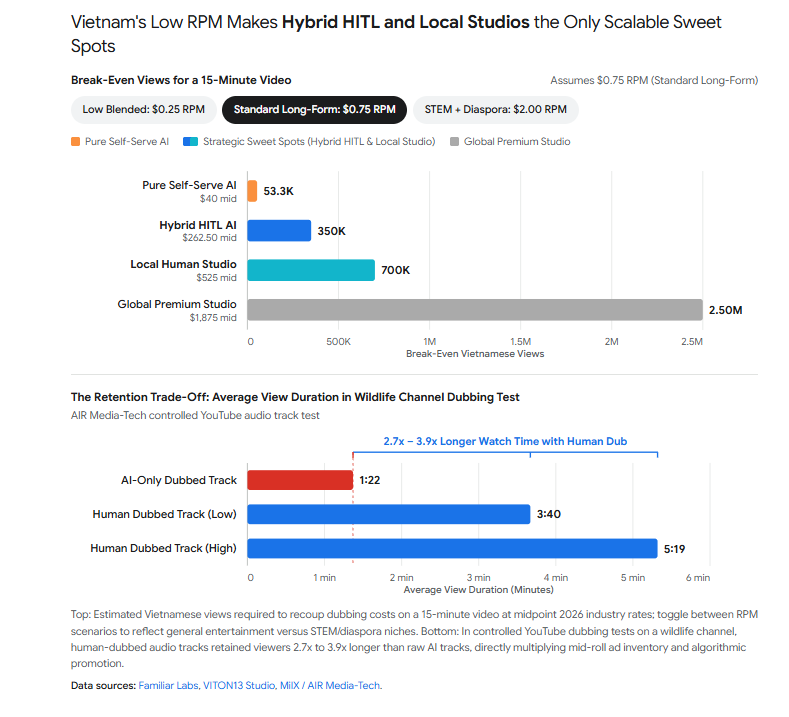
These thresholds explain current market behavior with precision. Paying a global broadcast studio $1,500–$2,250 per 15-minute video requires 2.5 million to 7.5 million Vietnamese views per upload to break even on standard or low-blended AdSense alone—volumes attainable only by global mega-franchises such as MrBeast, Like Nastya, or Vlad and Niki. Conversely, while a ~$40 pure AI dub clears break-even at 53,300 views (at $0.75 RPM), its elevated risk of viewer drop-off and negative commentary caps organic reach and can erode brand equity.
Between those extremes, Hybrid HITL AI ($150–$375) achieves break-even at 131,250 to 350,000 views in STEM or standard long-form niches, while direct-contracted local Vietnamese studios ($300–$750) break even at 262,500 to 700,000 views—becoming significantly more attractive once creators factor in multi-year evergreen backlist views, overseas Vietnamese diaspora RPMs, and local sponsorship upside.
Industry Trajectory and Future Trends (2026–2030)
Video localization is undergoing a structural budget reallocation rather than a simple replacement of human performers. Market estimates from DataNext Research (which vary across research firms depending on scope) project the AI dubbing and localization market expanding from $1.73 billion in 2026 to $15 billion by 2036 (24.1% CAGR)—growing more than three times faster than the broader $4.02 billion video localization industry (~7% annual growth). Separately, Dataintelo forecasts the AI-assisted voiceover localization market growing from $1.11 billion in 2025 to $5.13 billion by 2034 (18.5% CAGR). Leading infrastructure vendors underscore this momentum: ElevenLabs reached roughly $600 million in annualized revenue and a $22 billion valuation by September 2026 (used by 41% of Fortune 500 companies), while analyst estimates from SaaSGoodies project standard AI voice generation costs falling below $0.10 per minute on mainstream plans during 2027.
Five trends will define Vietnamese YouTube localization over the next three to five years.
Platform expansion will commoditize baseline Vietnamese dubbing. Given Vietnam’s 63.9 million YouTube users and 93% daily internet reach, YouTube’s omission of English-to-Vietnamese from native Auto-Dubbing is unlikely to persist indefinitely. As Google’s Gemini speech models improve on tonal Southeast Asian languages, outbound Vietnamese auto-dubbing, wider access to Multilingual Thumbnails (still in limited rollout in early 2026), and experimental AI lip-sync (currently piloting on select channels) are poised to broaden. Once free baseline Vietnamese auto-dubbing arrives, raw unedited AI tracks will lose differentiation completely, raising the bar so that human-refined or professionally acted audio becomes the primary competitive moat.
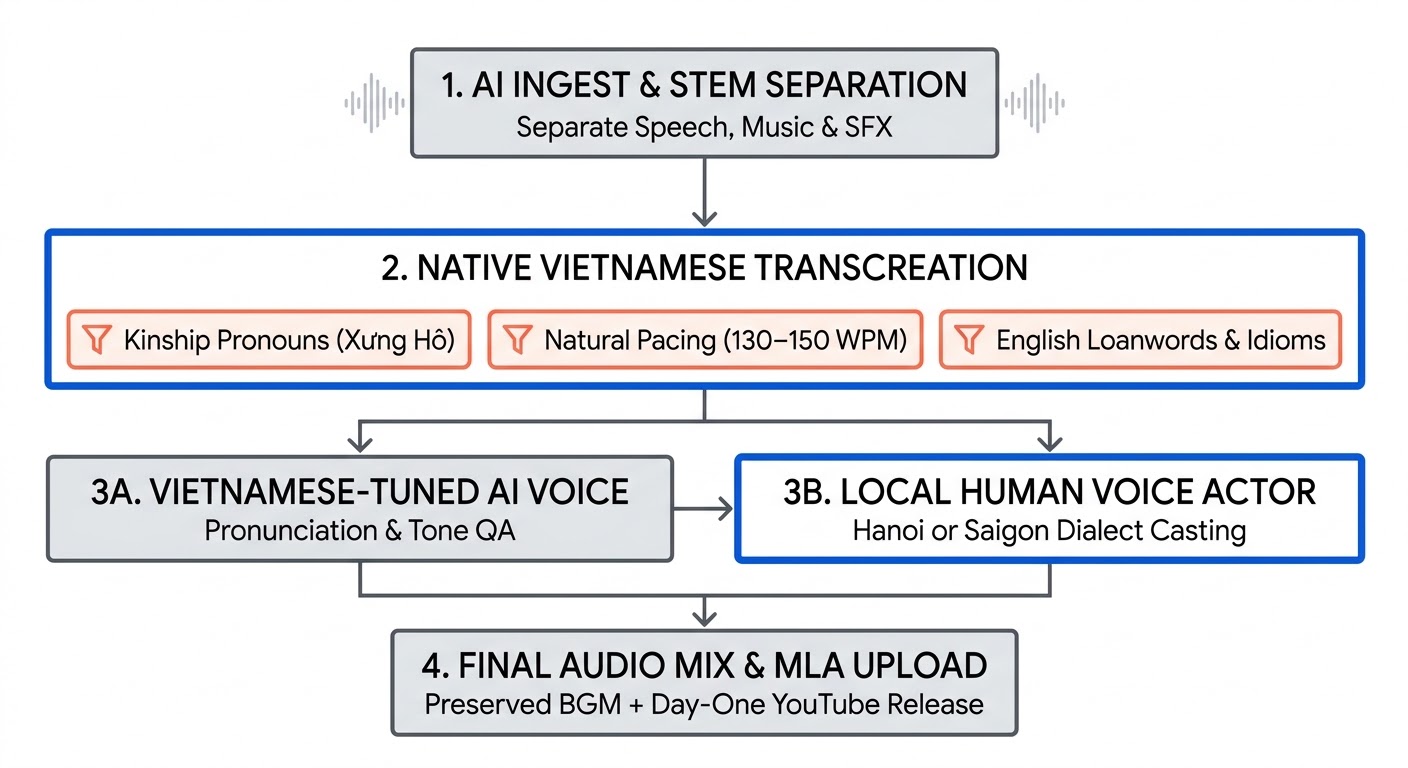
Hybrid “agentic plus human-in-the-loop” pipelines will become the production standard. The rigid binary between fully automated tools and traditional recording booths is dissolving. Over the coming years, agentic localization platforms (such as CAMB.AI, Dubformer, and ElevenLabs Productions) will automate transcription, multi-speaker separation, BGM stem preservation, lip-sync, and first-pass synthesis, while native Vietnamese localization specialists focus on high-leverage tasks: rewriting scripts for xưng hô accuracy and 130–150 WPM pacing, fixing code-switched technical vocabulary, auditing tonal slips, and recording human pickups for emotional climaxes. Industry analyses indicate this hybrid model captures roughly 80% to 90% of AI’s cost and speed savings while protecting viewer retention.
Dialect-aware models and licensed voice cloning will reshape talent economics. International platforms are racing to close the regional-accent gap currently owned by Vietnamese-native engines (Blaze, Vbee, Viettel AI), introducing region-specific dialects (Hanoi, Huế, Saigon) and improved cross-lingual speaker cloning. Simultaneously, voice-actor careers are bifurcating. While industry surveys project roughly 28% of voice actors reporting lost work in routine narration, thriving performers are moving either upmarket into high-emotion acting or into consented royalty-bearing voice marketplaces—demonstrated by over 10,400 creators earning more than $22 million in cumulative payouts on ElevenLabs’ marketplace as of 2026 (double the $11 million paid out through late 2025).
Consolidated MLA will remain the default entry point, with separate channels reserved for commercial depth. Drawing on operational data across 400+ localized channels at AIR Translation Labs, single-channel Multi-Language Audio has become the default starting strategy because pooling global watch time on one URL strengthens algorithmic authority—and AIR Media-Tech data notes that cross-using dubbed audio across related channels can lift total views by up to 45%. Dedicated Vietnamese sub-channels will persist selectively where channels seek local Vietnamese brand sponsorships, culturally tailored community posts, or kids’ programming ecosystems.
Platform authenticity enforcement and biometric voice consent will tighten. YouTube’s 2025–2026 policy updates draw a clear operational line: AI-voiced and AI-dubbed videos are explicitly permitted and monetized under standard CPM/RPM rules (with 110 monetized channels in the AIR Media-Tech network narrating with AI voices as of September 30, 2026), and cloning one’s own voice is exempt from YouTube’s “altered or synthetic content” disclosure label. Mandatory disclosure applies only when AI meaningfully alters or generates photorealistic media—such as making a real person appear to say or do something they did not, cloning someone else’s voice without consent, or fabricating realistic scenes—enforced via automatic AI detection labels rolling out since May 27, 2026. The real demonetization hazard is YouTube’s Inauthentic Content Policy (renamed from “repetitious content” in July 2025 and reinforced in January and July 2026), which targets templated, mass-produced videos lacking original human insight. Alongside legislative momentum such as the US NO FAKES Act (S. 4591, reported to the Senate in June 2026 and still pending passage as of October 2026), written biometric consent for voice cloning is fast becoming a mandatory legal standard.
Strategic Playbook for Producers Localizing into Vietnamese
For international creators, media companies, and localization teams seeking to capture Vietnam’s 63.9 million YouTube users profitably without triggering viewer backlash, execution should follow a disciplined, data-gated workflow built specifically around Vietnamese linguistic constraints.
Phase 1: Validate Organic Vietnamese Demand Before Committing Audio Budget
Following the sequencing playbook proven across 400+ channels at AIR Translation Labs, producers should verify Vietnamese pull before scaling production:
Localize Metadata and Subtitles First: Select your top 20% evergreen uploads and translate titles, descriptions, and tags into Vietnamese, backed by human-proofread Vietnamese subtitles ($7–$11/min through agencies, or AI-drafted with native proofreading). Monitor Vietnamese click-through rates, watch time, and comments for 60 days.
Use Language-Neutral Thumbnails: Until your channel receives YouTube’s Multilingual Thumbnails access, design clean, visual-first thumbnails free of embedded English text so foreign copy does not depress Vietnamese click-through rates.
Run a 5-Video Hybrid Pilot via Custom MLA: Because YouTube does not auto-dub English into Vietnamese, produce five custom Vietnamese audio tracks using a Hybrid HITL workflow and upload them via
YouTube Studio → Languages → Add language → Dub. Track performance underAnalytics → Advanced mode → Audio trackcross-referenced withGeography. Scale only if Vietnamese average view duration tracks close to your primary language baseline.
Phase 2: Match Your Localization Tier to Genre and Expected Vietnamese Scale
Rather than applying one production method across an entire catalog, align investment strictly with genre sensitivity and realistic per-video view targets:
| Channel Profile & Expected Vietnamese Views | Recommended Method | Target Budget (15-Min Video) | Recommended Stack / Partners |
| Science, Tech, Finance & Education (<350,000 VN views/video) | Hybrid HITL AI | $150 – $375 ($10–$25/min) | Native Vietnamese transcreator + ElevenLabs Eleven v3 (with manual retake selection), CAMB.AI, Dubformer (pronunciation glossary), or Vietnamese-specialized engines (Blaze, Vbee). |
| High-Energy Entertainment, Gaming, Comedy & Kids (>500,000 VN views/video or flagship IP) | Local Vietnamese Human Studio | $300 – $750 ($20–$50/min) | Direct partnerships with studios in Hanoi or Ho Chi Minh City (bypassing $120–$200/min Western agency markups) for authentic casting, slang adaptation, and 2–3 day turnarounds. |
| Massive Backlists & Shorts Market Testing | Stem-Preserved AI with Spot QA | $30 – $50 ($2–$3.33/min) | Self-serve AI dubbing (ElevenLabs Dubbing v2, HeyGen, Rask AI) strictly with BGM/SFX stem separation enabled; upgrade breakout winners to human or Hybrid HITL tracks. |
Phase 3: Enforce Four Vietnam-Specific Operational Mandates
Cast Dialect Deliberately: Select Northern (Hanoi) Vietnamese for documentaries, hard science, academic lectures, and finance where formal broadcast clarity reinforces trust. Select Southern (Ho Chi Minh City/Saigon) Vietnamese for lifestyle, gaming, pranks, comedy, vlogs, and channels seeking stronger connection with both Southern urban viewers and the high-RPM overseas Vietnamese diaspora.
Mandate Script Transcreation Over Literal Translation: Require translators to create a character xưng hô pronoun sheet prior to drafting, adapt idioms and jokes culturally, flag English technical loanwords for pronunciation QA, and tighten translated scripts to 130–150 WPM so speech breathes naturally against visual cuts.
Publish Vietnamese Tracks on Day One: As Mark Rober’s global release model illustrates, uploading dubbed tracks weeks after launch forfeits the peak 48-hour algorithmic surge. Lock English scripts early enough to feed your Vietnamese localization pipeline before release, publishing the Vietnamese MLA track simultaneously with the primary upload.
Monetize Beyond Domestic AdSense and Safeguard Compliance: Never evaluate Vietnamese localization solely against domestic $0.16–$0.80 AdSense RPMs; track blended earnings inclusive of Tier-1 diaspora viewership, layer in localized affiliate offers or regional sponsorships once traction builds (opening a separate Vietnamese channel only when local sponsorship demand justifies dedicated operations), obtain written biometric consent whenever cloning any human performer’s voice, and enable YouTube’s “AI use” disclosure toggle whenever photorealistic AI lip-sync or altered visuals are applied.